Glass powder is a versatile material used in construction, manufacturing, coatings, ceramics, decorative products, and many other applications. However, not all glass powder performs in the same way. One of the most important factors to consider is particle size.
Fine glass powder and coarse glass powder can look similar, but their performance, handling, and ideal uses can be quite different. Choosing the right type depends on what you want to achieve.
In this guide, we will explain the key differences between fine and coarse glass powder and help you decide which option is better for your project.
What Is Glass Powder?
Glass powder is produced by crushing and processing waste or manufactured glass into small particles. The material can be processed into different sizes depending on its intended application.
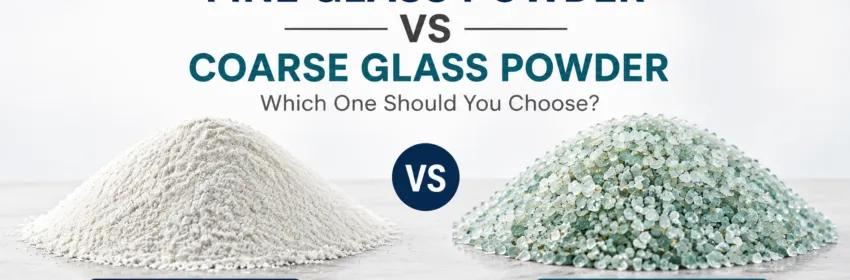
The main difference between fine and coarse glass powder is the size of the particles.
- Fine glass powder has smaller particles and a smoother texture.
- Coarse glass powder contains larger particles and provides a more granular texture.
Particle size can affect how glass powder behaves when it is mixed, processed, or applied.
What Is Fine Glass Powder?
Fine glass powder is made by grinding glass into very small particles. Because of its smaller particle size, it has a larger surface area compared with coarse powder.
Fine glass powder is often selected when a smooth mixture, better dispersion, or finer finish is required.
Common Uses of Fine Glass Powder
Fine glass powder can be used in several industries, including:
- Cement and concrete products
- Ceramics
- Glass and tile manufacturing
- Paints and coatings
- Fillers and composite materials
- Decorative surfaces
- Industrial manufacturing
Its fine texture allows it to blend easily with other materials. In applications where consistency and smoothness matter, fine powder can be a practical choice.
What Is Coarse Glass Powder?
Coarse glass powder contains larger glass particles. It is less finely ground than fine glass powder and usually provides a more noticeable granular structure.
Because the particles are larger, coarse glass powder can be useful when the material needs texture, visible particles, or a more open structure.
Common Uses of Coarse Glass Powder
Coarse glass powder may be used for:
- Decorative surfaces
- Terrazzo and flooring products
- Landscaping applications
- Concrete and construction materials
- Industrial fillers
- Decorative aggregates
- Surface texture applications
The larger particles can also make coarse glass powder easier to handle in certain production processes.
Fine vs Coarse Glass Powder: Key Differences
The biggest difference is particle size, but this difference can affect several other properties.
| Feature | Fine Glass Powder | Coarse Glass Powder |
|---|---|---|
| Particle size | Smaller | Larger |
| Texture | Smooth and soft | More granular |
| Mixing | Blends easily | Provides more visible particles |
| Surface finish | Generally smoother | More textured |
| Surface area | Higher | Lower |
| Best for | Fine mixtures and smooth finishes | Texture and decorative applications |
| Handling | Can produce more dust | Usually easier to handle |
These are general characteristics. The exact performance will depend on the glass type, particle-size distribution, processing method, and application.
Which Glass Powder Is Better for Concrete?
Both types can be useful in concrete-related applications, but the right choice depends on the desired result.
Fine glass powder can be considered when the goal is to create a more uniform mixture or use glass as a fine mineral component. Its small particles can distribute throughout the mixture more easily.
Coarser glass particles may be more suitable when the project requires visible aggregate or a decorative appearance.
For construction applications, it is important to consider the specific glass composition, particle size, and mix design rather than choosing based on size alone.
Which One Is Better for Decorative Applications?
If appearance is the main priority, coarse glass powder or larger glass particles may be the better option.
Larger particles are easier to see and can add texture and visual interest to decorative surfaces. They can work particularly well in products where glass is intended to become part of the visible design.
Fine glass powder is more suitable when you want the glass to blend into the material rather than stand out as individual particles.
Fine Glass Powder for Smooth Finishes
Fine powder is a strong option when you need a smooth and consistent material.
Its smaller particle size can help create a more uniform appearance when properly mixed with other materials. This makes it useful for applications where surface texture needs to remain relatively fine.
However, very fine powders can also require more careful handling because smaller particles may become airborne more easily.
Coarse Glass Powder for Texture and Visual Appeal
Coarse powder offers a different advantage: texture.
The larger particles can create a more distinctive surface and make the glass component easier to see. This can be valuable for decorative concrete, flooring, landscaping, and other visual applications.
If your goal is to highlight the glass rather than simply use it as a fine material, a coarser grade may be more appropriate.
How to Choose the Right Glass Powder
Before choosing fine or coarse glass powder, consider these five factors.
1. Consider Your Application
Start by asking what the powder will actually be used for.
A material intended for a fine mixture may require a different particle size than one intended for a decorative surface.
2. Think About the Desired Finish
Do you need a smooth appearance or a textured finish?
Choose fine glass powder when smoothness and uniformity are important. Consider coarse glass powder when visible particles and texture are desirable.
3. Check the Particle Size
Do not rely only on labels such as “fine” or “coarse.” Ask the supplier for the actual particle-size range.
Knowing the size distribution can help you select a product that matches your production requirements.
4. Consider Processing and Handling
Fine powder may disperse differently from coarse material and can require additional care during storage and handling.
Your production equipment and mixing process should also be compatible with the selected material.
5. Choose a Reliable Supplier
Quality can vary between suppliers. Consistent particle size, clean material, and reliable processing are important when glass powder is used in commercial or industrial applications.
A good supplier should be able to provide information about particle size, material composition, packaging, and recommended applications.
Can You Mix Fine and Coarse Glass Powder?
Yes, in some applications, using different particle sizes together can be useful.
A combination of fine and coarse particles can create a broader particle-size distribution. The fine particles can fill spaces between larger particles, while the coarse particles can provide texture and structure.
However, the ideal combination depends on the application. Testing a small sample before full-scale production is a good way to evaluate the result.
Fine or Coarse Glass Powder: Which Should You Choose?
There is no single answer because the best option depends on your project.
Choose fine glass powder if you need:
- A smoother texture
- Better blending into fine mixtures
- A more uniform appearance
- A fine mineral or filler component
Choose coarse glass powder if you need:
- More visible glass particles
- A textured surface
- Decorative effects
- A granular material
If you are unsure, discuss your application with a glass powder supplier and request the particle-size information and product specifications before making a decision.
Final Thoughts
Fine and coarse glass powders both have useful applications. The right choice comes down to particle size, desired finish, processing requirements, and the final purpose of the material.
Fine glass powder is generally better suited to applications where smoothness and uniform blending are important. Coarse glass powder can be a better choice when texture, visible particles, or decorative appeal are the priority.
Instead of choosing based only on the word “fine” or “coarse,” look at the actual particle-size range and match it to your project requirements. The right glass powder can help improve both the performance and appearance of your finished product.
