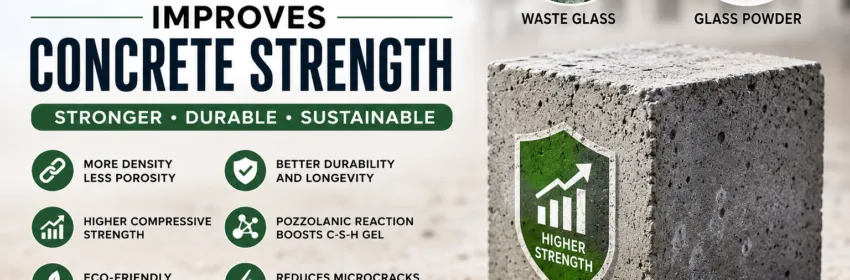
Concrete is one of the most widely used construction materials in the world. However, engineers and researchers are always looking for ways to make it stronger, more durable, and more sustainable. One material that has gained a lot of attention in recent years is glass powder.
Glass powder is made by crushing and grinding waste glass into a fine powder. When added to concrete, it can significantly improve its performance in several ways.
In this article, we will explore how glass powder enhances concrete strength and why it is becoming an important material in modern construction.
What is Glass Powder?
Glass powder is a finely ground material produced from recycled glass. Instead of sending glass waste to landfills, it is processed into a very fine, sand-like powder.
This powder is then used as a partial replacement for cement or fine aggregates in concrete mixtures.
How Glass Powder Improves Concrete Strength
1. Fills Micro Voids in Concrete
Concrete naturally contains tiny air gaps and voids. These weak points can reduce its overall strength.
Glass powder has extremely fine particles, which help fill these micro voids. This makes the concrete:
- Denser
- Less porous
- Stronger under pressure
A denser structure directly improves compressive strength.
2. Pozzolanic Reaction Boosts Strength
One of the most important benefits of glass powder is its pozzolanic behavior.
When glass powder reacts with calcium hydroxide (a by-product of cement hydration), it forms additional calcium silicate hydrate (C-S-H) gel.
This C-S-H gel is the main compound responsible for concrete strength.
3. Improves Long-Term Strength Gain
Concrete containing glass powder continues to gain strength over time.
Unlike traditional mixes that stabilize early, glass powder concrete:
- Strengthens gradually
- Becomes more durable with age
- Performs better in long-term structures
This makes it ideal for roads, bridges, and buildings.
4. Reduces Microcracks
Shrinkage and temperature changes can cause tiny cracks in concrete.
Glass powder helps reduce these cracks by:
- Improving particle packing
- Reducing internal stress
- Enhancing bond between materials
Fewer cracks mean higher structural integrity.
5. Enhances Durability Against Chemicals
Concrete is often exposed to harsh environments like:
- Sulfates
- Chlorides
- Moisture
Glass powder makes concrete more resistant to chemical attacks by reducing permeability. This protects the internal structure and maintains strength for longer periods.
6. Improves Workability and Density
Fine glass powder improves the flow and compaction of concrete mix. Better compaction results in:
- Fewer air pockets
- Higher density
- Improved load-bearing capacity
This directly contributes to higher compressive strength.
Key Benefits of Using Glass Powder in Concrete
- Increased compressive strength
- Improved durability
- Reduced permeability
- Eco-friendly construction material
- Better resistance to environmental damage
- Utilization of waste glass (sustainable solution)
Where Glass Powder Concrete is Used
Because of its improved strength and durability, glass powder concrete is commonly used in:
- Road construction
- Pavements and sidewalks
- Bridges and flyovers
- Industrial flooring
- Precast concrete products
Final Thoughts
Glass powder is not just a waste recycling solution—it is a powerful material that can significantly improve concrete strength and performance. By enhancing density, supporting pozzolanic reactions, and reducing microcracks, it makes concrete stronger and more durable over time.
As the construction industry moves toward sustainability, glass powder is becoming an essential ingredient in modern high-performance concrete.
