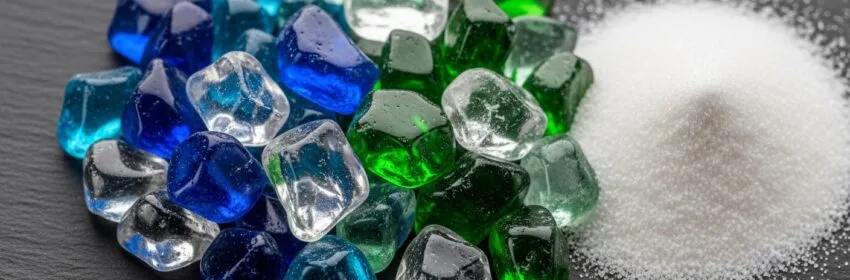
Glass, in its many forms, is one of the most versatile materials in modern industry. Once melted and processed, it doesn’t simply stay as a sheet or a bottle — it gets crushed, ground, and refined into a wide variety of granular and powdered forms, each engineered for specific tasks. Two of the most widely used forms areglass chipsandglass powder.
At first glance, you might assume they’re interchangeable — after all, both come from the same base material. But the reality is far more nuanced. The size, texture, surface area, and processing method of each form make them suited to entirely different industries, applications, and performance requirements.
In this guide, we’ll walk you through what each material is, how they differ, where they’re used, and which one might be the right choice for your project.
What Are Glass Chips?
Glass chips are small, irregular fragments of glass, typically ranging from 3mm to 25mm in size. They are produced by crushing and breaking down larger pieces of glass — whether from recycled bottles, plate glass, or specialty glass — into smaller, manageable pieces. The result is a coarse, angular or tumbled material with a textured surface.
Glass chips can be further processed to produce eithersharp-edged chips(angular, for abrasive applications) ortumbled/rounded chips(smooth edges, for decorative purposes). They are available in a variety of colors — clear, green, blue, brown, or custom-tinted — making them popular in both industrial and aesthetic applications.
Glass Chips
Size Range
Typically 3mm – 25mm. Coarse, chunky fragments visible to the naked eye.
Glass Chips
Texture
Angular (sharp) or tumbled (smooth edges). Surface remains rough and irregular.
Glass Chips
Appearance
Visually striking — refracts light beautifully. Available in clear, green, blue, brown.
Glass Chips
Primary Use
Decorative aggregates, road reflectivity, landscaping, filtration media, abrasives.
What Is Glass Powder?
Glass powder is produced by grinding glass down to an extremely fine particle size, typically ranging from a few micrometers (µm) to 100 microns, depending on the intended application. Unlike glass chips, glass powder is not visible as individual fragments — it appears as a fine, chalky or silky substance similar in look and feel to flour or cement powder.
The production of glass powder involves ball milling, jet milling, or other high-energy grinding processes that reduce glass to ultra-fine particles. This dramatically increases thesurface area per unit of mass, which is the key characteristic that makes glass powder so chemically reactive and versatile in technical applications.
To understand the full scope of what glass powder is and how it’s manufactured, visit our main resource: What is Glass Powder?
Glass Powder
Particle Size
As fine as 1–10 microns. Invisible to the naked eye — appears as a uniform powder.
Glass Powder
Surface Area
Extremely high surface area per gram — ideal for chemical and reactive applications.
Glass Powder
Appearance
White, off-white, or colored fine dust. Uniform, smooth, and consistent in texture.
Glass Powder
Primary Use
Construction binders, ceramics, coatings, paints, electronics, and specialty composites.
Key Differences: Glass Chips vs Glass Powder
Now that we’ve defined both materials, let’s compare them directly across the most important parameters that matter to buyers and engineers.
| Property | Glass Chips | Glass Powder |
|---|---|---|
| Particle Size | 3mm – 25mm | 1µm – 100µm |
| Visual Form | Visible fragments, coarse | Fine dust, uniform powder |
| Surface Area | Low – limited surface exposure | Very high – maximum exposure |
| Reactivity | Low – chemically inert at this size | High – pozzolanic activity possible |
| Decorative Use | Excellent – refracts light beautifully | Limited – used as pigment filler |
| Structural Binding | Not applicable | Yes – acts as supplementary binder |
| Processing Cost | Lower – less energy to produce | Higher – requires fine milling |
| Handling | Easy – manageable bulk material | Requires dust control measures |
| Applications | Decorative, filtration, roads | Concrete, ceramics, electronics |
| Eco-friendliness | Recycled glass, sustainable | Recycled glass, CO₂ reduction |
“The difference between glass chips and glass powder isn’t just size — it’s a fundamental shift in how the material interacts with its environment.”
Common Uses of Glass Chips
1. Decorative Landscaping & Architecture
One of the most popular uses of glass chips is in landscaping and interior design. Tumbled glass chips — with smooth, rounded edges — are used as mulch alternatives in gardens, pathway fillers, water features, and decorative ground cover. Their ability to refract sunlight creates a stunning visual effect that organic mulch simply cannot replicate.
2. Road Markings & Reflective Surfaces
Angular glass chips are widely used in road-marking paint asretroreflective beads. When headlights hit these chips embedded in road paint, they bounce light back toward drivers, significantly improving night-time road visibility and safety.
3. Water & Industrial Filtration
Crushed glass chips serve as effective filtration media in water treatment systems. They can replace traditional sand filters, offering similar or superior performance with a longer operational lifespan and the benefit of being made from recycled materials.
4. Abrasive Blasting
Certain angular glass chip formulations are used in abrasive blasting applications — cleaning surfaces, preparing metal for coating, or removing paint and corrosion from structures. Glass chips are preferred over some traditional abrasives because they produce less toxic dust.
5. Tile & Mosaic Inlays
In the decorative arts and construction industries, glass chips are incorporated into tiles, countertops, and mosaic designs to add color, texture, and a reflective quality to surfaces.
Common uses of glass chips at a glance:
- Garden landscaping, ground cover, and water features
- Road reflector strips and safety markings
- Water treatment and industrial filtration
- Abrasive blasting for surface preparation
- Decorative tile, mosaic, and countertop inlays
- Fish tank and aquarium substrate
- Terrazzo flooring aggregates
Common Uses of Glass Powder
1. Supplementary Cementitious Material (SCM) in Concrete
Perhaps the most technically significant use of glass powder is ingreen concrete production. Finely ground glass powder exhibits pozzolanic properties — meaning it reacts with calcium hydroxide in the presence of water to form compounds that strengthen concrete. Replacing a portion of cement with glass powder can reduce CO₂ emissions while maintaining or improving structural performance.
2. Ceramic & Glaze Manufacturing
Glass powder is a critical ingredient in ceramic manufacturing and glaze formulation. When fired at high temperatures, it melts and fuses, creating smooth, glossy, or matte surface finishes on pottery, tiles, and sanitary ware.
3. Paint & Coating Additives
Ultra-fine glass powder is added to specialty paints and coatings to improve scratch resistance, hardness, and optical properties. In some reflective paints, it serves as the active component that enhances visibility.
4. Electronics & Substrate Manufacturing
In electronics, borosilicate glass powder is used in the production oflow-temperature co-fired ceramics (LTCC)— substrates used in multilayer circuit boards, sensors, and microwave components. The powder’s controlled composition and fine particle size are essential for this precision application.
5. Thermal & Acoustic Insulation
Glass powder can be foamed or processed into insulation materials. Foamed glass, produced from glass powder mixed with foaming agents and fired at high temperatures, creates a rigid, lightweight insulation product used in construction and cryogenic pipelines.
- Green concrete and pozzolanic cement replacement
- Ceramic glazes and fired ceramic bodies
- Specialty paints, coatings, and adhesives
- Electronics substrates (LTCC) and semiconductor packaging
- Foamed glass insulation panels
- Dental and medical device manufacturing
- Frit and flux in glass manufacturing
Benefits of Each Material
Benefits of Glass Chips
- Aesthetically superior— The refractive quality of glass chips adds visual depth and sparkle to surfaces that no other aggregate can match.
- Durable and weather-resistant— Unlike organic mulch, glass chips do not decompose, fade quickly, or harbor pests.
- Environmentally sustainable— Made from 100% recycled glass, diverting waste from landfill.
- Inert and non-toxic— Safe for use in water features, garden beds, and fish tanks.
- Versatile sizing— Available in a range of sizes for different applications and aesthetics.
Benefits of Glass Powder
- Pozzolanic reactivity— Improves concrete durability and strength while reducing cement content.
- Reduces carbon footprint— Replacing cement with glass powder significantly lowers construction-related CO₂ emissions.
- Excellent chemical resistance— Glass powder adds chemical stability to composites and coatings.
- High surface area— Makes it ideal for reactive and coating applications where surface contact matters.
- Recyclable raw material— Like chips, glass powder utilizes recycled glass, contributing to circular economy goals.
Did You Know?Research published in construction journals has demonstrated that replacing 10–30% of ordinary Portland cement with finely ground glass powder can increase concrete compressive strength and reduce permeability — making structures more resistant to water and chemical attack over time.
Which One Should You Choose?
The choice between glass chips and glass powder comes down entirely to your intended application. Here’s a simple framework to guide your decision:
Choose glass chips if you need:a visible, decorative material — for landscaping, road safety, or architectural finishing. Also choose chips if you need filtration media or an abrasive. The coarser form is easier to handle, lower in cost per unit, and delivers outstanding visual results.
Choose glass powder if you need:a technical material that integrates at a molecular or microscopic level — such as in concrete, ceramics, coatings, or electronics. The high surface area and fine particle size are non-negotiable requirements for these applications.
Many projects in construction, art, and manufacturing may actually benefit fromboth— using glass powder in the binding matrix and glass chips in the surface finish, for example in decorative concrete panels or terrazzo flooring.
Final Thoughts
Glass chips and glass powder represent two distinct expressions of the same foundational material. Understanding their differences isn’t just an academic exercise — it directly impacts the quality, durability, cost, and environmental impact of your project.
Glass chips shine (literally) in applications where visual impact and physical presence matter. Glass powder, by contrast, works quietly behind the scenes — binding, strengthening, and enhancing materials at a microscopic level.
Both materials represent the future of sustainable construction and design, putting recycled glass to work in innovative, high-value ways. If you’d like to learn more about how glass powder is made and where it’s used across industries, visit our in-depth guide:What is Glass Powder?— the resource that covers everything from manufacturing processes to industry-specific applications.
